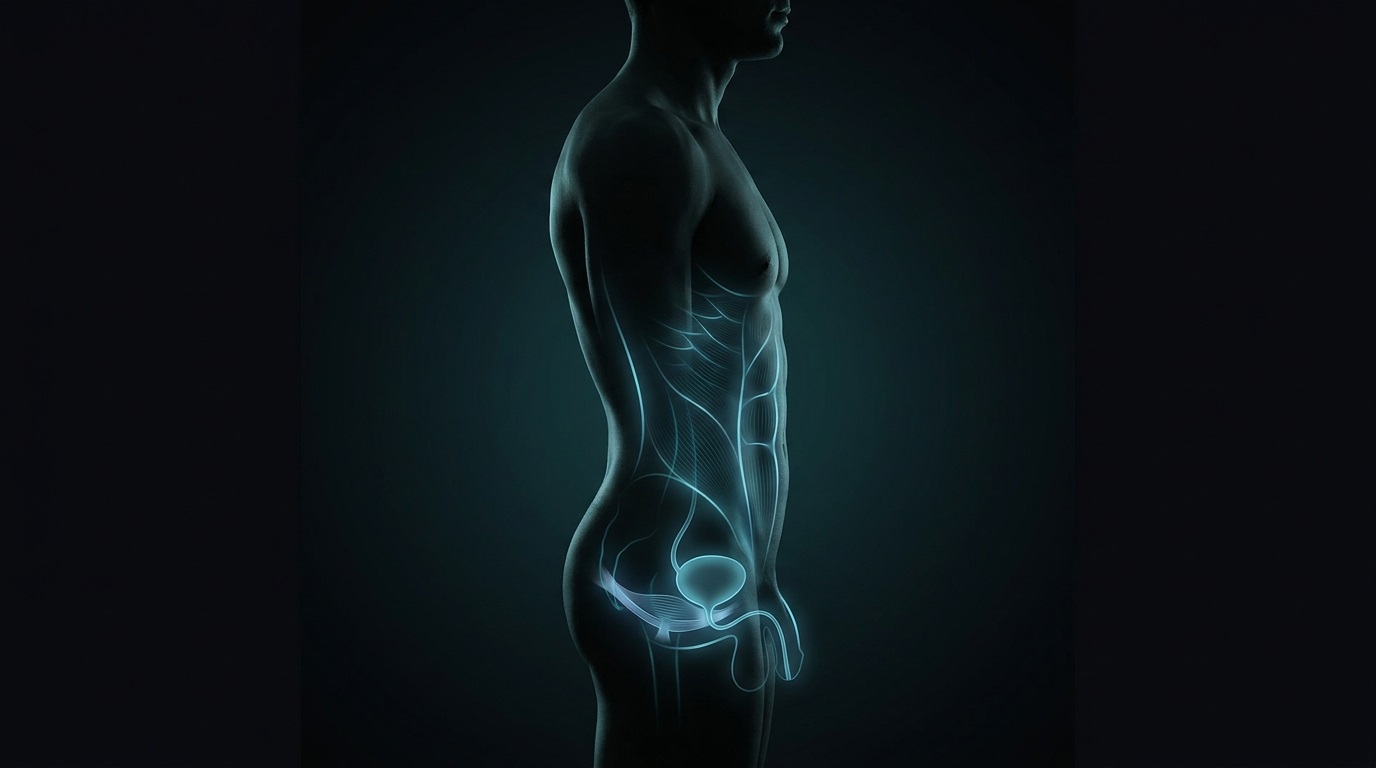
Male Pelvic Floor Anatomy: What It Is and Where It Sits
The male pelvic floor is a layered sheet of muscles and connective tissue that spans the base of the pelvis, supporting the bladder and rectum while controlling continence, erection and ejaculation.
Where the male pelvic floor is located
Picture a hammock stretched across the bottom of your pelvis. The male pelvic floor attaches to the pubic bone at the front, the tailbone at the back, and the two sitting bones at the sides. It forms the structural floor of the abdominal cavity, holding the bladder and bowel in position and surrounding the openings of the urethra and anus. Because it wraps around these openings, it acts as a voluntary valve that you can consciously tighten and release.
A useful mental model of the male pelvic floor anatomy is three functional layers: a deep supportive layer that carries the weight of the organs above, a middle layer involved in urinary control, and a superficial layer that includes the muscles responsible for erection and ejaculation. When people search for a male pelvic floor muscles diagram, this layered hammock spanning pubic bone to tailbone is what they are looking at.
The key male pelvic floor muscles
Three muscles do most of the work that matters for men:
- Pubococcygeus (PC): the central muscle of the pelvic floor, running from the pubic bone to the coccyx. It is the primary muscle you contract during a Kegel and the main contributor to urinary continence.
- Bulbocavernosus (BC): wraps around the base of the penis. It compresses the deep dorsal vein during erection to maintain rigidity and contracts rhythmically during ejaculation.
- Ischiocavernosus (IC): sits along the crura of the penis and works with the BC to sustain the firm phase of an erection.
Together these muscles explain why the male pelvic floor is so closely tied to both bladder control and sexual function. They are skeletal muscles — the same kind you train at the gym — which means they respond to progressive exercise and weaken with disuse.
Signs of a Weak Male Pelvic Floor
The most common signs of a weak male pelvic floor are urinary leakage, post-void dribbling, a weak stream and difficulty sustaining an erection — symptoms that often appear gradually and are easy to dismiss.
Urinary signs
Urinary symptoms are usually the first noticeable indicator of male pelvic floor weakness. Watch for:
- Leakage with effort: small losses of urine when coughing, sneezing, laughing or lifting (stress incontinence).
- Post-void dribbling: a few drops escaping after you think you have finished urinating, often staining underwear.
- Weak or interrupted stream: reduced force or difficulty fully emptying the bladder.
- Urgency: a sudden, hard-to-defer need to urinate.
Sexual and structural signs
Because the bulbocavernosus and ischiocavernosus are pelvic floor muscles, weakness frequently shows up as sexual symptoms too: difficulty maintaining an erection (blood drains from the corpora cavernosa faster than the muscles can compress the veins), reduced ejaculatory control, and weaker orgasmic contractions. Some men also describe a vague sensation of pelvic heaviness or a feeling that the area lacks tone.
What Causes Male Pelvic Floor Problems
Male pelvic floor weakness is most often caused by aging, prostate surgery, chronic straining, excess weight and simple disuse — factors that gradually reduce the muscles' tone and coordination.
The most common causes
- Aging: like all skeletal muscle, the pelvic floor loses mass and tone over time if it is not actively used.
- Prostate surgery: radical prostatectomy can disrupt continence mechanisms, which is why pelvic floor rehabilitation is a standard part of recovery.
- Chronic straining: repeated heavy lifting, chronic constipation or a persistent cough place sustained downward pressure on the pelvic floor.
- Obesity: excess abdominal weight increases the constant load the pelvic floor must support.
- Sedentary lifestyle and disuse: muscles that are never consciously activated gradually weaken — the single most reversible cause.
The encouraging part is that most of these causes act through the same final pathway: reduced muscular strength and coordination. That is exactly what targeted training can rebuild, which is why pelvic floor exercises for men have such well-documented benefits.
How to Strengthen the Male Pelvic Floor
The most evidence-based way to strengthen the male pelvic floor is structured Kegel training: progressively contracting and releasing the pelvic floor muscles every day, building strength over 6 to 12 weeks.
The pelvic floor exercises men benefits
Two landmark studies illustrate why training the male pelvic floor is worth the effort. For continence after prostate surgery, Filocamo et al. (2005) found that men who began early pelvic floor rehabilitation reached 96% continence at 6 months, compared with 65% in the control group. For erectile function, Dorey et al. (2004) reported that 40% of men fully recovered normal erectile function after structured pelvic floor training, with a further 34.5% showing significant improvement.
96% vs 65% continence at 6 months with early pelvic floor rehabilitation (Filocamo et al., 2005 — PMID 16002204) 40% full recovery of erectile function with structured training (Dorey et al., 2004 — PMID 15527607)
How to find and contract the right muscle
To locate your pelvic floor, imagine stopping the flow of urine midstream and lifting upward — that inward-and-up sensation is the contraction you want. Avoid recruiting the glutes, abdomen or inner thighs; place a hand on your belly and buttocks to confirm they stay relaxed. A correct Kegel feels like lifting, not bearing down.
A simple starting routine is three sets of ten contractions per day, holding each for 5 to 10 seconds with an equal period of full release between repetitions. Quality matters more than quantity: a few well-isolated, maximal contractions outperform many half-hearted ones. Most men notice better muscle awareness within 4 to 6 weeks and functional gains in continence and erection quality between 6 and 12 weeks.
For the full step-by-step technique, the progressive 6-week protocol, common mistakes and the exact set-and-rep structure, see our complete guide: Kegel Exercises for Men: The Complete Guide. It is the natural next step once you understand the anatomy covered here.

Train Your Pelvic Floor with PrimeFlow Core
PrimeFlow Core builds a personalized Kegel protocol based on your level and goal, guiding each contraction so you train the right muscle with the right intensity, day by day.
Discover PrimeFlow CoreHow to Relax a Tight Male Pelvic Floor
Not every pelvic floor problem is weakness — some men have an overactive, chronically tight pelvic floor, which is relieved by learning to release the muscles rather than strengthen them.
If you experience pelvic pain, a constant urge to urinate, or discomfort that worsens when you do Kegels, the issue may be excessive tension rather than weakness. To relax male pelvic floor muscles, focus on the opposite of a Kegel:
- Diaphragmatic breathing: breathe slowly into the belly and let the pelvic floor gently drop and bulge outward on each exhale.
- Reverse Kegels: instead of lifting up and in, consciously release downward and out, as if softening the area.
- Avoid constant clenching: many men unconsciously hold tension all day; periodic check-ins to consciously let go help reset baseline tone.
When to See a Professional
See a urologist or pelvic floor physiotherapist if you have persistent leakage, pelvic pain, sudden erectile dysfunction, blood in the urine, or no improvement after three months of correct training.
Pelvic floor training is safe, low-risk and a sensible first step for most men with mild symptoms. But it is not a substitute for medical evaluation. A urologist can rule out non-muscular causes — such as infection, prostate conditions or vascular disease — while a pelvic floor physiotherapist can confirm whether the muscles are weak or overactive and tailor a program accordingly. Early assessment is especially important after prostate surgery, where structured rehabilitation measurably improves continence outcomes.